July 16, 2026
Inkling Is Mira Murati's First Model, Priced at $1.87/$4.68 With a Launch Rate That Expires Tomorrow
Subscribe
Thinking Machines Lab shipped a 975-billion-parameter open-weight model on July 15 under Apache 2.0, the highest-scoring U.S. open-weights model on the Artificial Analysis index, with intro Tinker pricing that rises roughly 50% on July 17. That is the same day Gemini 3.5 Pro's unconfirmed target falls due, and Google's pricing page still lists no Pro row. DeepSeek V4's mid-July launch window stays open with peak pricing not yet active and the legacy API retiring July 24.
Inkling: 975B params, 41B active, Apache 2.0, and a 50%-off rate that ends July 17
Mira Murati's Thinking Machines Lab shipped its first model on July 15, 2026. Inkling is a Mixture-of-Experts transformer with 975 billion total parameters and 41 billion active per token, pretrained on 45 trillion tokens of text, images, audio, and video, and released under a full Apache 2.0 license. The model card is dated July 15. Weights are on Hugging Face, and a NVFP4 quantized version halves the GPU memory requirement (about eight Nvidia B300s or sixteen H200s at native 16-bit, per The Register).
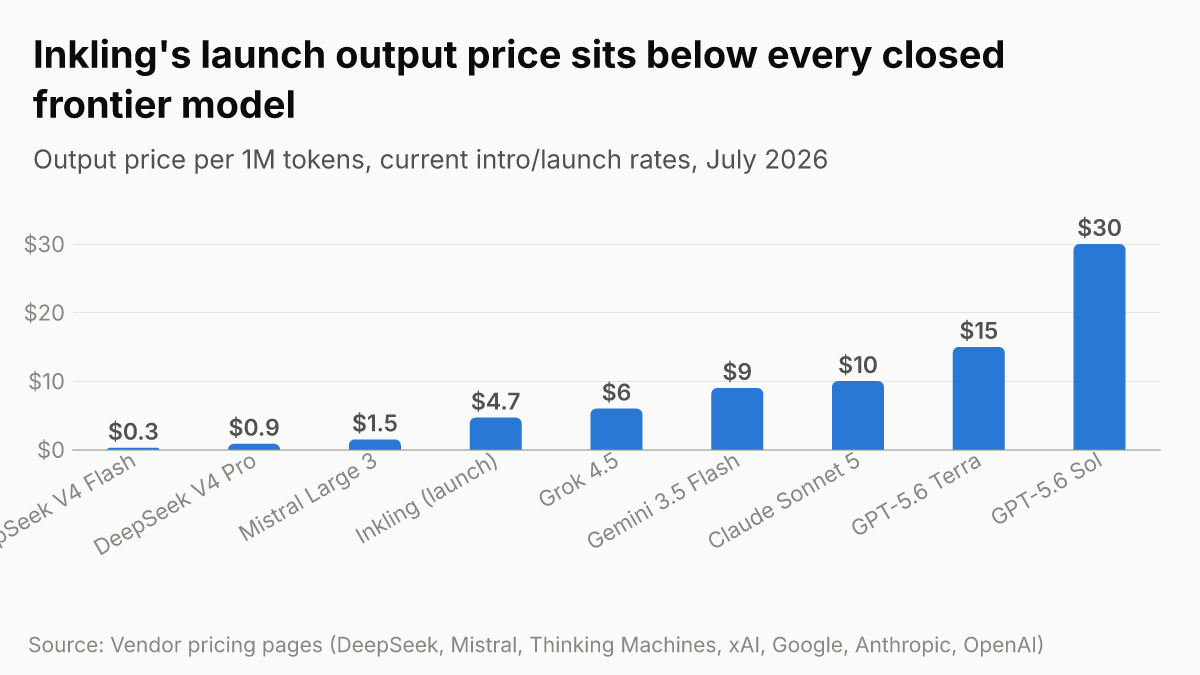
The pricing is the part that fits this beat. Thinking Machines does not sell Inkling through a metered API the way OpenAI or Anthropic do. It sells inference and fine-tuning through Tinker, its customization platform. At the 64K-context tier, Inkling costs $1.87 per million input tokens (Tinker calls this "prefill") and $4.68 per million output ("sample"), with cached input discounted 80% to $0.374. The 256K tier exactly doubles both, to $3.74 input and $9.36 output, with a separate $5.61-per-million train rate for fine-tuning at 64K. Third-party inference is live on Together AI, Fireworks, Modal, Databricks, and Baseten.
The fine print that matters: those are launch rates. The launch post says plainly, "We are offering Inkling at a 50% discount for a limited time." Tinker's own pricing page states the platform-wide change coming tomorrow: "Due to rising compute costs, we are also increasing our prefill and sample prices by ~50% and our train prices by ~10% starting July 17." Every model on that page carries a "Limited-time 50% discount" tag, and the table shows a clean old-to-new jump for the other discounted models (Nvidia's Nemotron-3-Ultra goes from $1.66 to $2.49 input, $4.15 to $6.225 output). If you want to trial Inkling at the sticker rate, this week is the window.
The company is unusually honest about where the model lands. The launch post: "Inkling is not the strongest overall model available today, open or closed." It scores 41 on the Artificial Analysis Intelligence Index, which Thinking Machines says makes it the leading U.S. open-weights model by that measure, above Nvidia's Nemotron 3 Ultra, though Chinese open weights (DeepSeek V4, GLM 5.2, Kimi K2.6) still hold the overall open lead. The pitch is customizability over benchmark position: Inkling is a fine-tuning base, and Tinker lets the model write and run its own fine-tuning jobs. Bridgewater Associates is already a Tinker customer, per the Economic Times.
Alongside the flagship, Thinking Machines shared a preview of Inkling-Small, a lighter 12-billion-active-parameter model trained on a similar recipe, with weights coming once testing completes. Murati founded the company in February 2025 with roughly 200 employees and a reported $2 billion seed at a $10 billion valuation, and built Inkling in about nine months on Nvidia GB300 NVL72 systems.
Gemini 3.5 Pro: one day from its reported target, and Google's pricing page still has no Pro row
The query people search most on this beat right now is "Gemini 3.5 Pro release date." The answer has not changed since yesterday: July 17 is the widely reported target, and Google has confirmed nothing. Google's Gemini API pricing page still lists only Gemini 3.5 Flash at $1.50 per million input and $9.00 per million output (standard tier), with batch and flex tiers at half that. There is no Gemini 3.5 Pro row, no model card, no gemini-3.5-pro model ID, and no pricing of any kind.
The July 17 date traces to TechTimes reporting (July 8 and July 13) and Business Insider, which frames it as an internal target rather than an announcement; Google declined to comment in the BI report. At I/O on May 19, Sundar Pichai said Pro was in internal testing and would come "next month," meaning June. It slipped once to early July, then to July 17. A July 6 Geeky Gadgets item attributed a further delay to a scrapped base model and extended pre-training, citing a YouTube channel called Universe of AI. None of that is Google-sourced.
What Google has actually committed to, at I/O, is a 2-million-token context window and a Deep Think reasoning mode (Ultra-gated). Everything a buyer needs, pricing, per-token rates, rate limits, regions, whether Deep Think is a free toggle or a metered add-on, is unpublished. The only generally available Google frontier today remains Gemini 3.5 Flash at $1.50/$9, GA since May 19. Treat July 17 as the date to watch, not a date to plan around: a lab that has slipped twice can slip a third time, and the only signal that the launch has actually landed is a row on that pricing page.
DeepSeek V4: mid-July window open, peak pricing still not active, legacy API retires July 24
DeepSeek's official V4 launch is still due in mid-July, and the window is open but the launch has not landed. The tell is the pricing page: it still shows only the baseline off-peak rates, V4 Pro at $0.435 per million input (cache miss) and $0.87 per million output, V4 Flash at $0.14/$0.28, with 1M context and 384K max output. The peak-pricing row that TechNode reported on June 30 (a 2x surcharge during Beijing business hours, 9 to 12 and 14 to 18, which is 1 to 4 am and 6 to 10 am UTC) is not yet active. When that row appears, the launch has happened.
The hard deadline is unchanged and now eight days out. The legacy deepseek-chat and deepseek-reasoner aliases retire on July 24, 2026 at 15:59 UTC, per the official changelog. Until then they transparently route to V4 Flash. After that, requests using the old names fail. DeepSeek is the first frontier API to schedule time-of-day pricing, so when the peak row goes live it is worth re-checking not just the rate but your workload's time distribution.
Current prices: what the models people actually compare cost today
All prices are per 1 million tokens, input then output, at the standard pay-as-you-go tier. Links go to each vendor's official pricing or docs page. Rates verified July 16, 2026.
- GPT-5.6 Sol: $5 / $30, 1.05M context, 128K max output. OpenAI, GA Jul 9. Cache writes 1.25x, reads 90% off, 30-min minimum life.
- GPT-5.6 Terra: $2.50 / $15, 1.05M context. OpenAI, GA Jul 9. Half of GPT-5.5's former price.
- GPT-5.6 Luna: $1 / $6, 1.05M context. OpenAI, GA Jul 9.
- Claude Sonnet 5: $2 / $10, intro pricing through Aug 31. Anthropic. Sep 1 it goes to $3/$15, and the new tokenizer emits roughly 30% more tokens, so effective cost is about $3.90/$19.50.
- Claude Opus 4.8: $5 / $25. Anthropic. The mid-tier reference point.
- Gemini 3.5 Flash: $1.50 / $9, standard tier. Google, GA May 19. Batch and Flex tiers halve both to $0.75/$4.50.
- Grok 4.5: $2 / $6, 500K context. xAI, launched Jul 8. Not on the batch-discount list (4.3 and 4.20 get 20% off). Priority tier is 2x.
- DeepSeek V4 Pro: $0.435 / $0.87, 1M context, 384K max output. DeepSeek, preview. Cache hit $0.003625. Peak 2x surcharge pending.
- DeepSeek V4 Flash: $0.14 / $0.28, 1M context. DeepSeek, preview. The cheapest frontier-context option on this list.
- Meta Muse Spark 1.1: $1.25 / $4.25, 1M context (active management), $0.15 cached. Meta, preview, US-only waitlist. Meta's first paid model.
- Mistral Large 3: $0.50 / $1.50, Apache 2.0, 675B/41B-active MoE. Mistral. A frontier open-weight MoE is in early access, GA later this summer, no name or price yet.
- Inkling: $1.87 / $4.68 at 64K context, cached 80% off ($0.374); 256K tier doubles to $3.74/$9.36. Thinking Machines / Tinker, launched Jul 15, Apache 2.0 open weights. Launch rates rise roughly 50% on Jul 17.
Tracking
- Fable 5 included access ends July 19 (Sunday, 3 days out), the third extension (Jun 23 to Jul 7 to Jul 12 to Jul 19). After that, every Fable token is credits-only at $10/$50, double Opus 4.8 and the top of Anthropic's rate card. Applies to Pro, Max, Team, and premium Enterprise, with a 50% weekly cap. No fourth extension is announced, but each prior move came at the wire. BleepingComputer.
- Rumor: a "Claude Honeycomb EAP" model briefly appeared inside Cursor, fueling community talk that an Opus 5 could land before month-end. The New Stack reported it July 13 alongside the Fable extension. This is unverified and Anthropic has not commented. Treat as rumor.
- OpenAI July 23 deprecation wave (7 days out):
gpt-5-chat-latest,gpt-5.1-chat-latest, five Codex variants,computer-use-preview, and the deep-research models. The basegpt-5.4model is NOT on the list, confirmed against the official deprecations page. - Sonnet 5 standard pricing takes effect Sep 1: $3/$15, plus the ~30% tokenizer inflation, for an effective $3.90/$19.50, more than Sonnet 4.6's $3/$15. Anthropic.
- Mistral frontier open-weight MoE remains in early access with no name, specs, or price. GA is still "later this summer." Mistral.
Want the next one?
Every new AI Releases & Pricing issue by email. One tap to unsubscribe.