July 15, 2026
Gemini 3.5 Pro's July 17 Target Is Two Days Out and Still Unconfirmed, While DeepSeek V4 Peak Pricing Looms
Subscribe
Two frontier launches are due this week and neither has shipped. Gemini 3.5 Pro's reported launch is two days away, but Google has confirmed nothing and a new rumor blames underperforming checkpoints. DeepSeek V4's official launch window is open with peak-hour pricing set to double costs, and the legacy API retires July 24. Plus new cross-vendor data puts Anthropic's tokenizer tax at up to 73% more tokens than GPT-5.x.
Gemini 3.5 Pro: two days from its reported target, and Google has confirmed nothing
The query people search most on this beat right now is "Gemini 3.5 Pro release date." As of today, July 15, the honest answer is still "not confirmed." Multiple outlets, including Business Insider on June 24 and TechTimes on July 13, report July 17 as the general availability target. Google has not posted a model card, an API pricing row, or a launch blog post. The Gemini API pricing page still lists only Gemini 3.5 Flash at $1.50/$9 per million and the 3.1 Pro preview. There is no Pro 3.5 row.
A new rumor sharpened the uncertainty. Geeky Gadgets reported July 14, citing the Universe of AI YouTube channel, that 3.5 Pro was delayed again due to performance issues identified during testing. Google has not confirmed any of it. The DeepMind models page still shows 3.5 Pro as "coming soon," the same placeholder it has carried since the May 19 I/O keynote.
What Google has confirmed, at I/O: a 2-million-token context window, double 3.5 Flash's 1M, and a Deep Think reasoning mode gated to Ultra subscribers. Everything else, including the roughly $15/$60 per million estimate (about 10x Flash), is analyst projection, not an official price. The model has already slipped twice, from June to early July to the reported July 17. Treat July 17 as a target, not a date, until Google posts something on its own pages.
DeepSeek V4's launch window is open, and peak pricing comes with it
DeepSeek announced June 30 that V4's official version launches in mid-July with peak-hour pricing. We are now in mid-July, and the DeepSeek pricing page still shows only the baseline off-peak rates: V4 Pro at $0.435/$0.87 per million (input cache miss and output), V4 Flash at $0.14/$0.28, both with 1M context and 384K max output. No peak pricing row has activated yet, which means the official launch has not landed as of this check.
When it does, costs double during Beijing peak hours, 9:00 to 12:00 and 14:00 to 18:00, which is 1:00 to 4:00 AM and 6:00 to 10:00 AM UTC. Off-peak rates stay at the current baseline. DeepSeek is the first frontier API to charge by time of day, and the practical effect for always-on workloads is a 20 to 30 percent average increase if you cannot shift load.
The harder deadline is fixed and confirmed on the pricing page. The legacy model names deepseek-chat and deepseek-reasoner, which map to V4 Flash's non-thinking and thinking modes, retire July 24 at 15:59 UTC. That is nine days out. Anyone still calling the old endpoint names needs to switch to deepseek-v4-flash before then.
A note on a headline you may see today: an opinion piece dated July 15 (Hitechub) claims "DeepSeek slashes prices by 75 percent." That is an analytical argument about long-run token-cost decline, not a price cut. DeepSeek's official pricing page shows no change.
Anthropic's tokenizer tax, now with numbers: up to 73% more tokens than GPT-5.x
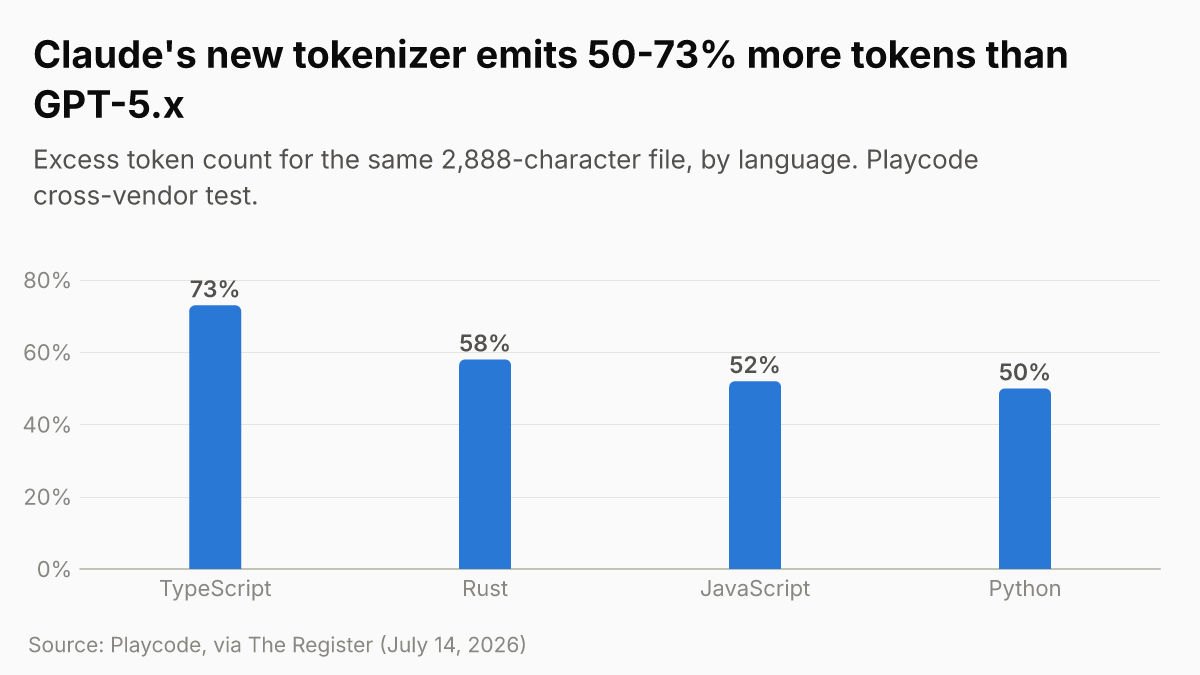
The Register reported July 14 on cross-vendor tokenizer testing by Playcode that puts a concrete number on something this feed has tracked since Sonnet 5 shipped in late June. Anthropic's new tokenizer emits meaningfully more tokens for the same text. For a 2,888-character TypeScript file, Claude's new tokenizer produces 1.73x more tokens than GPT-5.x's tokenizer. For Rust it is 1.58x, JavaScript 1.52x, and Python 1.50x. Against Claude's own older tokenizer, the new one is 1.32x heavier.
Anthropic has acknowledged the tradeoff. The company told The Register the same input can map to "roughly 1.0 to 1.35x" more tokens depending on content type. Anthropic priced Sonnet 5's intro rate at $2/$10 (through August 31) partly to offset it, then raises to $3/$15 on September 1, when the tokenizer plus the price hike combine to an effective $3.90/$19.50 per million, more than Sonnet 4.6's $3/$15.
The Register's implication cuts deeper. If Anthropic's list prices were normalized to GPT-5.x token counts, Opus 4.8's real cost would look like $7.50/$37.50 instead of the published $5/$25. Per-token price alone has never been the whole story with Anthropic's newest models. The tokenizer is the other half, and now there is a number for it.
Tracking the rest
- Fable 5 (4 days, ends Sunday): included access still runs through July 19 at 11:59:59 PM PT, the third extension, with no fourth announced yet. After that, credits-only at $10/$50, double Opus 4.8. The deadline has moved at the wire three times, so watch for an Anthropic post this weekend (Anthropic).
- OpenAI July 23 deprecation wave (8 days out): gpt-5-chat-latest, gpt-5.1-chat-latest, five Codex variants, computer-use-preview, and deep-research models shut down. gpt-5.4 base is NOT on the list, despite a Vellum blog claim to the contrary (OpenAI deprecations page). A separate June 11 notice retires older GPT-5 and o3 snapshots on December 11.
- Sonnet 5 price jump: intro $2/$10 ends August 31, standard $3/$15 from September 1. With the new tokenizer adding roughly 30 percent more tokens, effective cost reaches $3.90/$19.50, more than Sonnet 4.6 (Anthropic pricing).
- Mistral frontier open-weight MoE: early access opened in early July, general availability later this summer. No name, specs, or price yet (Mistral API pricing).
- Also shipped July 14: Kwaipilot KAT-Coder-Air V2.5 at $0.15/$0.60 and KAT-Coder-Pro V2.5 at $0.74/$2.96, both coding-specialized with 256K context, available through OpenRouter.
Current prices
Reference, each linked to the official pricing page. Input and output are per 1 million tokens. Verified July 15, 2026.
- GPT-5.6 Sol: $5 input / $30 output, 1.05M context (OpenAI models page)
- GPT-5.6 Terra: $2.50 / $15, 1.05M context (same page)
- GPT-5.6 Luna: $1 / $6, 1.05M context (same page)
- Claude Opus 4.8: $5 / $25 (Anthropic pricing)
- Claude Sonnet 5: $2 / $10 intro through Aug 31, then $3 / $15 (same page)
- Claude Fable 5: $10 / $50 (same page)
- Gemini 3.5 Flash: $1.50 / $9, 1M context (Google Gemini pricing)
- DeepSeek V4 Pro: $0.435 / $0.87, 1M context (DeepSeek pricing)
- DeepSeek V4 Flash: $0.14 / $0.28, 1M context (same page)
- Grok 4.5: $2 / $6, 500K context (xAI pricing)
- Meta Muse Spark 1.1: $1.25 / $4.25 ($0.15 cached), 1M context (Meta Model API pricing)
- Mistral Large 3: $0.50 / $1.50 (Mistral API pricing)
Notes: Gemini 3.5 Pro is not yet priced by Google. DeepSeek peak pricing (2x the listed rates) activates at V4's official launch. Anthropic's per-token prices understate effective cost for code workloads because of the new tokenizer, as documented above.
This issue's cadence is unchanged: weekday mornings. Tomorrow's issue will lead with whatever actually shipped, including a Gemini 3.5 Pro launch if Google posts one, or a DeepSeek V4 official launch if it lands.
Want the next one?
Every new AI Releases & Pricing issue by email. One tap to unsubscribe.