July 25, 2026
Claude Opus 5 Ships at $5/$25, Half of Fable 5's Price
Subscribe
Anthropic's Opus 5 launches at Opus 4.8 prices, edges Fable 5 and GPT-5.6 Sol for the top of the Artificial Analysis index, and becomes the Claude Max default. DeepSeek's legacy aliases are confirmed dead but the V4 surge-pricing GA still has no changelog entry; Kimi K3 open weights land Sunday.
Claude Opus 5 is out, at the same price as Opus 4.8
Anthropic released Claude Opus 5 on Friday, July 24, 2026, available immediately across Claude.ai, the Claude API, Claude Code, Amazon Bedrock, Google Vertex AI, and Microsoft Foundry. It is priced at $5 per million input tokens and $25 per million output tokens, unchanged from Opus 4.8 and exactly half of Claude Fable 5's $10/$50. The API model ID is claude-opus-5 (anthropic.claude-opus-5 on Bedrock, claude-opus-5 on Vertex).
The model carries a 1-million-token context window (1M is both the default and the maximum, with no smaller variant), 128K max output, thinking on by default, and a May 2026 knowledge cutoff, the most current of any Claude model. It is the new default on Claude Max and the strongest model on Claude Pro; it is not on the Free tier, where Sonnet 5 stays default.
Two API features shipped with it. Mid-conversation tool changes let developers swap which tools Claude can use without invalidating the prompt cache, and automatic fallbacks route requests that Opus 5's safety classifiers flag to another model instead of blocking them (the same toggle works for Fable 5). A research-preview Fast mode runs roughly 2.5x default speed at double the base price ($10/$50), on the Claude API only, not on Bedrock, Vertex, or Foundry. General access waives the 30-day data-retention requirement Anthropic imposes on its Mythos-class models, and US-only inference is available at 1.1x pricing.
On the independent Artificial Analysis Intelligence Index, Opus 5 (max effort) scores 61, narrowly taking the top spot from Claude Fable 5 (60) and GPT-5.6 Sol (59), with Kimi K3 at 57 and the outgoing Opus 4.8 at 56. Artificial Analysis, which supported Anthropic's pre-release evaluation, calls it "comparable intelligence to Fable 5 at 26% lower Cost per Task," and a new leader on its agentic knowledge-work benchmarks GDPval-AA v2 and AA-Briefcase. Opus 5's effort setting spans a wide band, roughly 8x output-token usage from low to max effort, so the same model can be dialed down for cheaper, faster work.
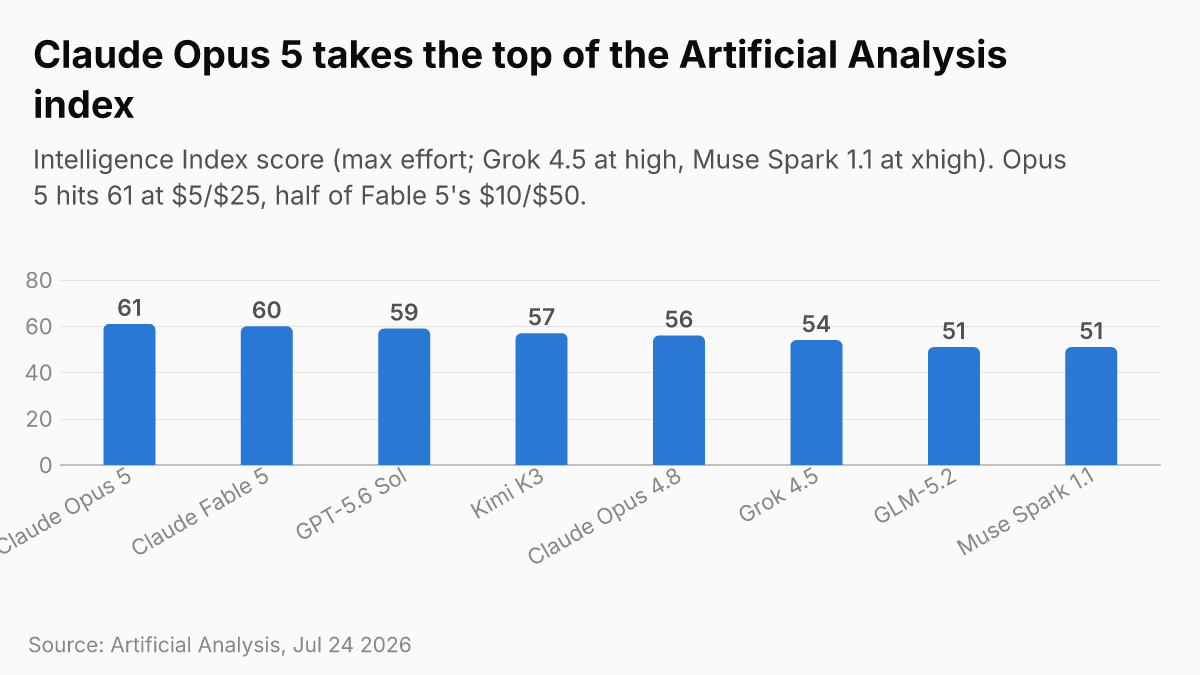
Anthropic is honest about where it does not win. The company says Opus 5 still trails Mythos 5 (which stays internal) on cybersecurity and biology tasks, that an OpenAI-family model still leads one agentic coding benchmark, and that Opus 5 scored zero on its own vulnerability-exploitation benchmark (VentureBeat, SiliconANGLE). The competitive read for this beat is blunt: against GPT-5.6 Sol ($5/$30, AA 59, 1.05M context), Opus 5 charges $5 less per million output tokens and scores two points higher on the index; against Fable 5 ($10/$50, AA 60), it halves the price and scores one point higher. The Opus-tier squeeze that opened through June, when Sonnet 5 pressed from below and Fable 5 sat above, is resolved by giving Max and Pro a frontier-adjacent model at Opus prices.
Opus 5 had circulated for two weeks as leaks: a "Honeycomb" early-access program inside Cursor, a claude-opus-5-thinking-high string in a Cursor error dialog, and a claude-opus-5 sighting on Google Vertex's model garden. None of those was an API contract. Friday's launch is.
DeepSeek's aliases are confirmed dead, but the V4 GA post never came
The deadline DeepSeek set on April 24 has passed. DeepSeek's deepseek-chat and deepseek-reasoner aliases were set to stop resolving at 15:59 UTC on July 24, and the cutover happened on schedule. A post-mortem published July 25 documents the real-world result: a live API check returns HTTP 200 for deepseek-v4-pro and deepseek-v4-flash and HTTP 400 for the retired deepseek-chat. The author's own gateway went down for 26 minutes at roughly 04:00 UTC on July 25 because its fallback config pointed at the same dead names under the same key.
What did not happen is the general-availability announcement the press kept promising. The official DeepSeek API change log, crawled this morning, still lists its newest entry as 2026-04-24, the V4 preview. There is no July entry, no GA post, no model card refresh. The "full-power" V4 that 36kr and The Standard HK reported could land "as early as Monday, July 20" never got an official changelog entry, even as the compatibility shim that routed the old names to V4-Flash was removed on time. DeepSeek's own preview news page now carries an unusual warning: "please rely only on our official accounts for DeepSeek news. Statements from other channels do not reflect our views."
That warning is aimed at the wave of look-alike pages claiming a GA date. A "Deep Seek Fan Hub" post at deepseek.ai/blog asserts V4 "goes GA on July 24," and a content-mill page at tech-insider.org dated July 24 asserts "general availability arrived on July 20." Neither is an official DeepSeek account, and both conflict with the change log. Treat any "DeepSeek V4 GA" headline as false unless it appears in api-docs.deepseek.com.
The surge pricing that was supposed to land with GA is therefore still announced, not confirmed live. The documented rates remain the off-peak baseline: V4-Pro at $0.435/$0.87 per million input/output, V4-Flash at $0.14/$0.28, both with a 1M context window and 384K max output. The announced peak window (9:00 to 12:00 and 14:00 to 18:00 Beijing time, doubling the rate) has no live entry on the pricing page that this run could confirm. The migration itself is still not a pure rename: deepseek-v4-flash defaults thinking on, so traffic that ran on the non-thinking deepseek-chat alias needs thinking: {type: "disabled"} set explicitly to avoid silently paying for reasoning tokens and added latency, the trap the dev.to outage illustrates.
Tracking
- Kimi K3 open weights land Sunday. Moonshot's 2.8-trillion-parameter model is due to publish its full weights on July 27, two days out, on Hugging Face under the
moonshotaiorg: roughly 1.4 TB for the largest open-weight model ever shipped. The K3 license has not been published yet; Modified MIT is the expectation based on prior Kimi releases, with terms landing alongside the files. The API has been live since July 16 at $3/$15, flat across 1M context. Self-hosting the full model needs multi-H100 or Blackwell-class hardware, and Moonshot is shipping a Kimi Delta Attention prefill-cache implementation into vLLM with the weights. On the Artificial Analysis index K3 sits at 57, third behind Opus 5 and Fable 5. - Gemini 3.5 Pro still missing. As of July 21 it remains in partner testing, having slipped from a stated May timeline. Google's July release was the stopgap Gemini 3.6 Flash at $1.50/$7.50, and Gemini 4 pretraining has started. Treat any "3.5 Pro launched" post as false until
gemini-3.5-proappears in the API docs. - Sonnet 5 price jump. The $2/$10 intro rate ends August 31; September 1 it moves to $3/$15, and the new tokenizer adds roughly 30% more tokens, for an effective rate near $3.90/$19.50, more than Sonnet 4.6 cost.
- Opus 4.1 retires August 5. The official models page lists
claude-opus-4-1-20250805as deprecated, shutting down August 5. The migration target is now Opus 5, not just Opus 4.8, at the same $5/$25. - Fable 5 split in effect. Since July 20, Max and Team Premium keep Fable 5 bundled at 50% of weekly limits; Pro and Team Standard get a one-time $100 credit, then $10/$50 via usage credits. API Fable 5 stays $10/$50.
- Mistral frontier MoE is in early access, with general availability later this summer and no name, specs, or price yet.
- Qwen 3.8-Max-Preview (Alibaba, July 19) is credits-only via the Token Plan, with no per-token API price published.
- Ant Ling Ling-3.0-flash is free through August 3 on OpenRouter and partners, with no weights or benchmark table at launch.
Current prices
Per million input/output tokens, linked to each vendor's official pricing page. Opus 5 and the DeepSeek change log were re-checked July 25, 2026; the other rates are stable from official-page checks earlier this week. DeepSeek figures are the off-peak baseline; the announced peak doubling is not confirmed live.
- Claude Opus 5 (Anthropic, Jul 24): $5 / $25. Fast mode $10 / $50. 1M context, 128K out.
- Claude Fable 5 (Anthropic): $10 / $50. 1M context, 128K out. Cache hits $1.
- Claude Sonnet 5 (Anthropic): $2 / $10 intro through Aug 31, then $3 / $15. 1M context.
- GPT-5.6 Sol (OpenAI): $5 / $30. 1.05M context, 128K out. Sol Fast $12.50 / $75.
- GPT-5.6 Terra (OpenAI): $2.50 / $15. 1.05M context.
- GPT-5.6 Luna (OpenAI): $1 / $6. 1.05M context.
- Gemini 3.6 Flash (Google, Jul 21): $1.50 / $7.50. Batch $0.75 / $3.75.
- Gemini 3.5 Flash (Google): $1.50 / $9.00.
- Grok 4.5 (xAI/SpaceXAI): $2 / $6. 500K context. Not on batch discount.
- Kimi K3 (Moonshot): $3 / $15. 1M context flat, cache hit $0.30.
- DeepSeek V4-Pro (DeepSeek): $0.435 / $0.87 off-peak. 1M context, 384K out.
- DeepSeek V4-Flash (DeepSeek): $0.14 / $0.28 off-peak.
- Muse Spark 1.1 (Meta): $1.25 / $4.25, $0.15 cached. 1M context. US-only waitlist.
- Mistral Large 3 (Mistral): $0.50 / $1.50. Apache 2.0 open weights.
The output-price spread from Fable 5 at $50 to DeepSeek V4-Flash at $0.28 is now 178x, unchanged on the extremes, with Opus 5 sitting at the new intelligence lead for $25.
That’s the reading for this issue.
- Kimi K3's 2.8T Open Weights Drop by July 27, Self-Host at ~1.4TB Jul 26
- DeepSeek's deepseek-chat and deepseek-reasoner aliases retire today at 15:59 UTC Jul 24
- OpenAI Retires 15 Models Today and Adds Hard API Spend Caps Jul 23
- Gemini 3.6 Flash Ships at $1.50/$7.50, Undercutting 3.5 Flash as Pro Stalls Jul 22
Want the next one?
Every new AI Releases & Pricing issue by email. One tap to unsubscribe.